

What is change management?
Change management is (hopefully) an intentional, thoughtful, proactive process of guiding organisational change. It begins by preparing and planning for change and continues through implementation. Our goal is always to embed change capabilities, ensuring they become part of the fabric of the organisation and are sustainable, long-term.
In our fast-paced world, it’s easy to find change management examples of organisations responding to specific internal and external changes. Here are just a few possible scenarios:
- Integration of new systems and technologies
- Development and delivery of new products and services
- Responding to shocks in the market or external environment (such as COVID, or a financial crash)
- Organisational restructures and leadership changes
- Lagging performance
What are the key principles of change management?
“People don’t resist change. They resist being changed.”
― Peter Senge
There are a few simple, starting principles that are relevant for all change management:
Articulate: Always start by interrogating the impetus for change; a strong “why” that goes beyond the idea that doing something is better than doing nothing.
Be intentional: Don’t let change management be an afterthought, start thinking about proactive change management as far upstream as possible.
Understand: Know your organisation’s change readiness: your current status, capacity, and openness to change is an important starting point for tailored intervention.
It is also useful to understand the different types of change that organisations may need to navigate, each requiring different types of change management.
Change usually falls into these categories (in order of scale and complexity of change):
EVOLUTIONARY | Incremental (or developmental): rather than something completely new, this kind of change is about continuous improvements to strategy, products and services, processes and systems, ways of working. |
RESPONSIVE | Transitional: a change that is spurred by the need to implement or integrate a new process, system, or way of working. Something is ending, and something new is necessary. |
Adaptive: there is a need to change in response to external changes in the operating environment around the organisation. | |
REVOLUTIONARY | Transformational: a radical, reshape of the entire organisation requiring fundamental changes to business model, operating model and/or culture. This is where InkDot most often operates. |
What are the 5 C’s of change management?
Each of the types of change outlined above requires different change management strategies, which need to be grounded in the specific context and reality of each organisation. No matter the type of change, it isn’t going to be linear or follow a pre-defined pathway. Each organisation’s journey is unique.
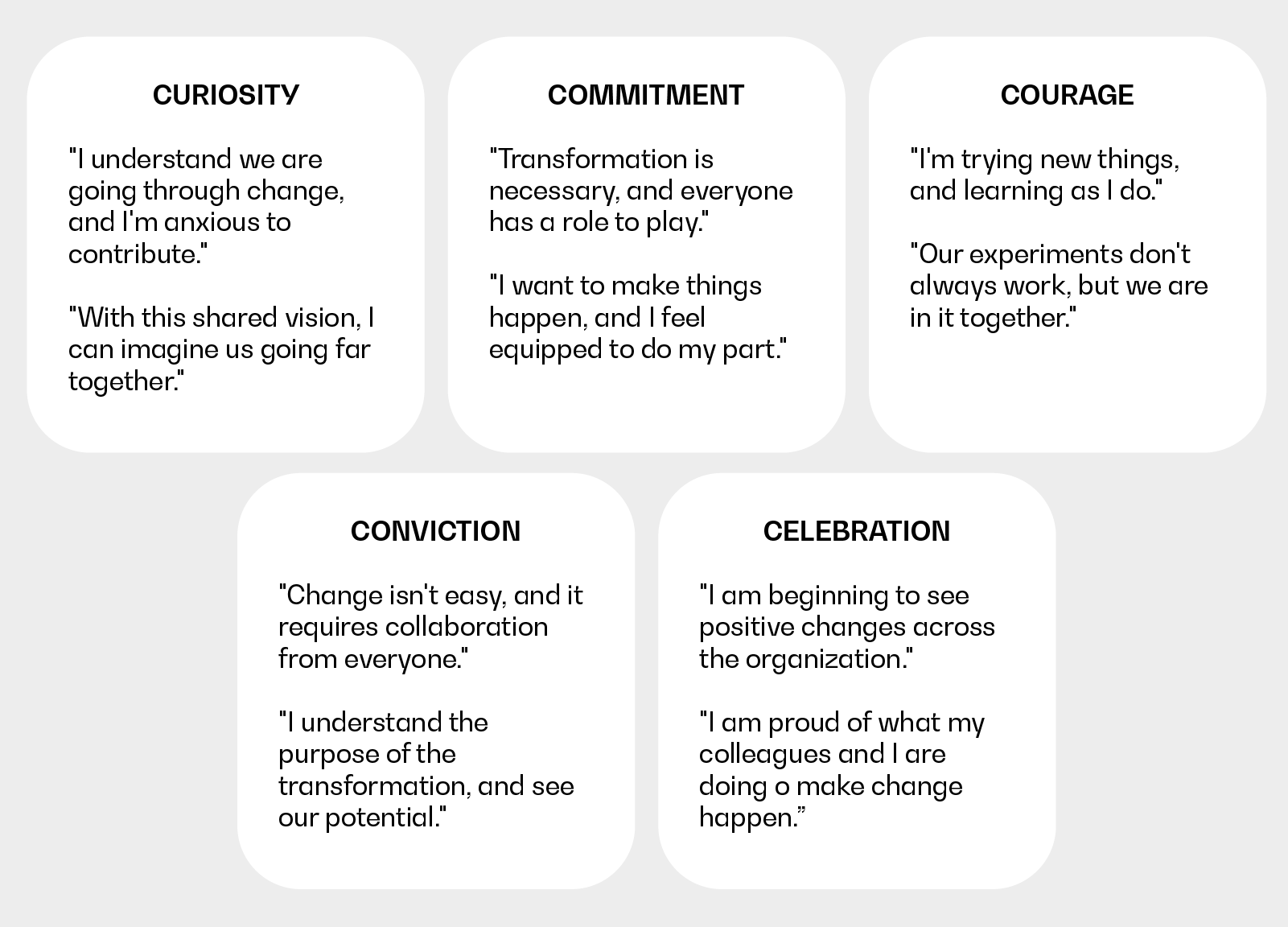
At InkDot, we specialise in ensuring change is participatory – happening through, with, and among the people, teams, and leaders of your organisation. An employee experience through a change journey might guide the organisation through these 5 Cs:
- Curiosity – “I understand we are going through change, and I’m anxious to contribute.”
- Commitment – “I want to make things happen, and I feel equipped to do my part.”
- Courage – “Our experiments don’t always work, but we are in it together.”
- Conviction – “Change isn’t easy, and it requires collaboration from everyone.”
- Celebration – “I am proud of what my colleagues and I are doing to make change happen.”
How do I create a change management process?
Know that most (if not all) organisational change requires people to move through change. Whether good or bad, change requires a period of processing and adaptation, which looks different person-to-person, and team-to-team. Change is both time and energy consuming, so expect people’s bandwidth to be less during a period of intensive change.
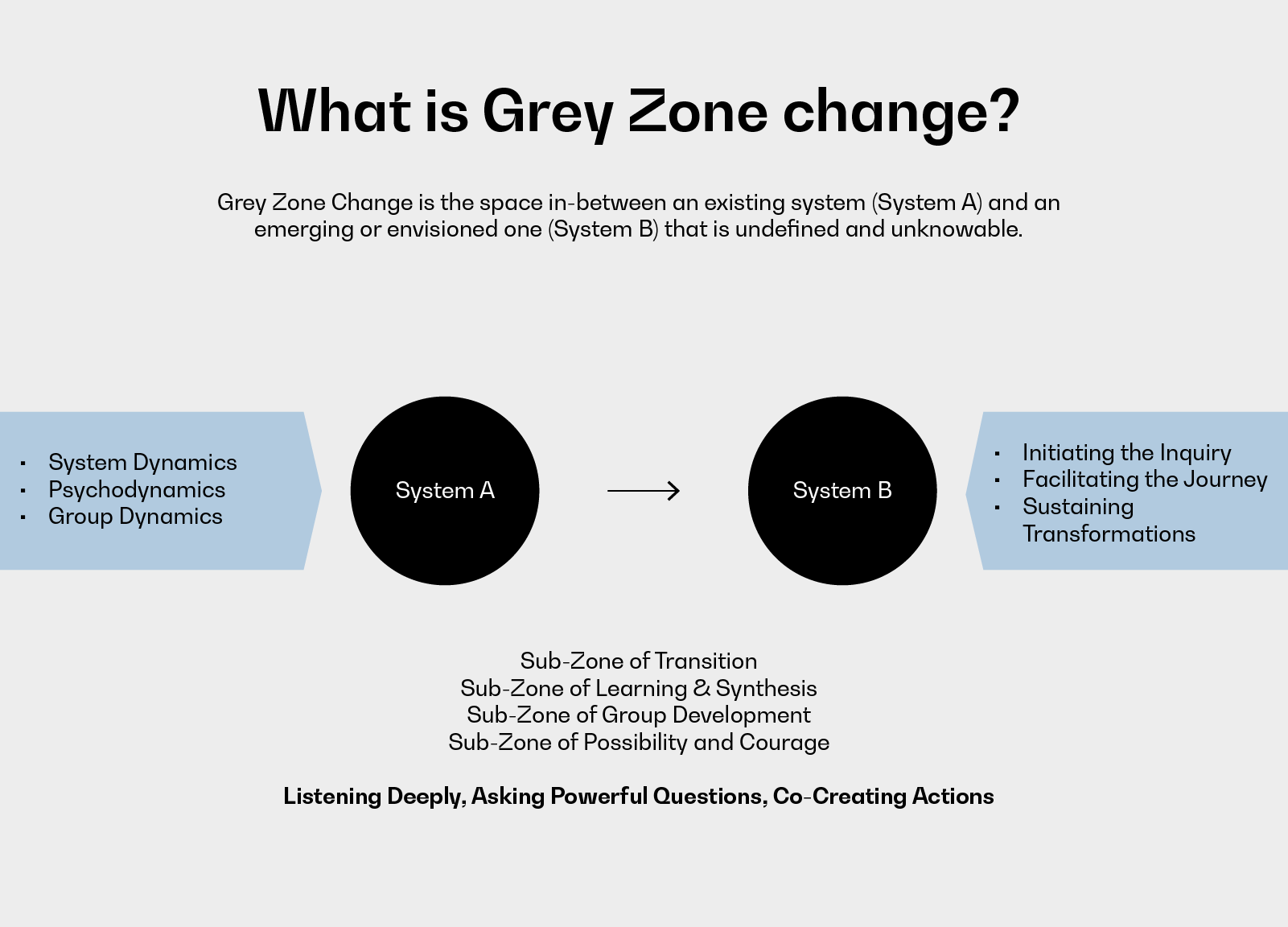
There are many change management models, but we often use “Grey Zones” by Dr. Yabome Gilpin-Jackson to ground our work. The Grey Zone change is the space between an existing system (System A) and an emerging or envisioned one (System B) that is still undefined and unknowable. This model encourages listening deeply, asking powerful questions, and co-creating actions as you move through change.
Real Impact Requires Real Commitment
Real impact requires more than managing change — it requires building the capacity to navigate it with confidence and intention. We support organisations in doing exactly that: turning uncertainty into opportunity, and change into a source of growth. We are ready to help you weigh the risks of change and to get strategic about building the capacity to navigate, face, and contend with change in a generative way that is filled with possibilities.
You can book a Discovery Call to explore ways to build the change capacity in your organisation
