

What makes effective team dynamics?
Working with teams is impactful because change happens in context. Behaviours, actions, and decisions of team members get reinforced by the team environment, so it makes sense to work with the whole to encourage a self-sustaining feedback loop. Teams also have influence on the rest of the system: changes in one team’s norms and behaviours can have a noticeable ripple effect out into the broader organisation.
Leadership (especially C-suite leaders) can use teams as leverage points for transformation by identifying the groups that represent and display behaviours that lead to innovation, and lifting them up for others to see.
When thinking about group dynamics examples that make a team effective, we need to be clear on organisational goals and purpose. Team dynamics are only effective if they fulfil this purpose.
How do you influence team dynamics?
When you build a clock, you follow a proven clock design to make it tick – easy! A complex system doesn’t work that way: there is no such thing as a perfect team dynamics formula.
A team is always in flux, and any form of change management within team dynamics needs to work with the shifting connections, evolving relationships, and inner-team interactions. Innovation becomes possible in teams that allow for movement and the emergence of the unexpected.
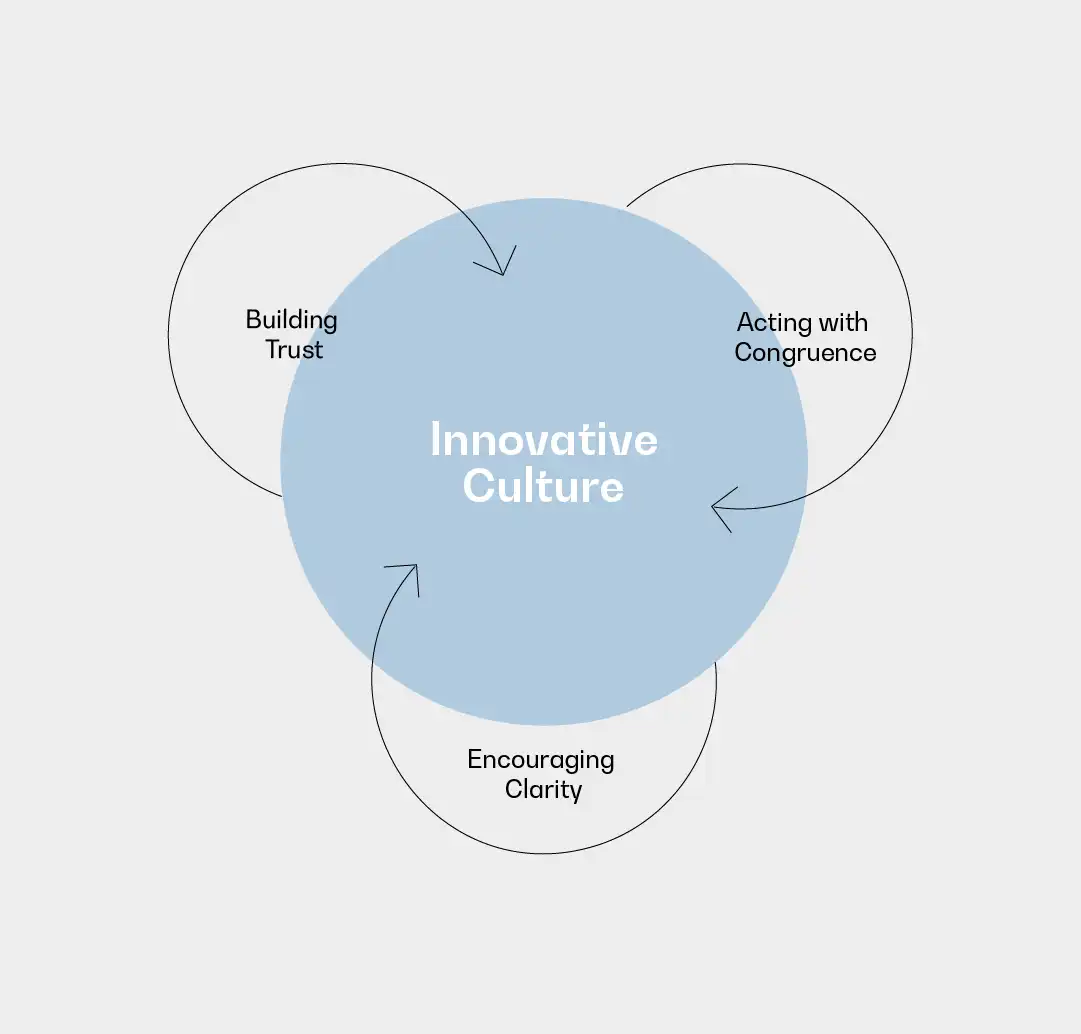
“The interrelated team dynamics that lead to innovation, or a culture of innovation, are those that build trust, encourage clarity, and communicate and act with congruence. Trust because it opens up space for risk-taking, experimenting, and encourages vulnerability. Clarity because it’s where team members should place their energy and attention – not having all the answers, but setting clear expectations and practising continuous alignment to ensure all involved remain on the same page. And congruence because it unites what we say and do, and encourages a continuous effort to be consistent.”
– Kathy, Employee Experience Manager | InkDot
Negative team dynamics often emerge from the opposite of these, and lead to a feeling of unfairness or a deterioration of a sense of justice. We are social creatures with a strong radar for what feels inclusive, fair, and equitable. Even if it’s hard to pinpoint, a team dynamic is quickly undermined by a lack of trust, lack of clarity, and lack of congruence.
How do you fix a bad team dynamic?
If you are worried about your team’s dynamic, the first thing to do is recognize the complexity of your team. It’s not something to be “fixed,” like a clock. So, how to improve team dynamics in the workplace?
As a starting point, allow the dynamics to reveal themselves. Even though you don’t want unhelpful dynamics to become embedded in culture, you do need to get comfortable with allowing tensions to emerge.
Sometimes the right thing to do is nothing, allowing a dynamic to run its course.
When a more direct intervention is necessary, it should be grounded in the team’s own understanding and acknowledgement of the dynamic. Understanding and acknowledgement won’t be generative based on assumptions. What is required is to consciously and actively reflect on what is igniting the tension and what is needed to move towards trust, clarity, or congruence. Then, a new path forward can be crafted by the team itself.
How to create positive group dynamics?
As a team dynamic begins to shift and a team transformation begins to take hold, it is important to observe and recognise the evolution taking place. Positive group dynamics take root if they are positively reinforced and lead to an outcome that serves the group more readily than before.
If you are ready to create positive team dynamics to transform your team and organisation, we’re ready to help.
Improve Your Team Dynamics
As facilitators working alongside you, our team at InkDot helps to nurture the dynamics that lead to healthy, effective, innovative teams. It is critical to deconstruct, gently demolish, and let go of negative dynamics to rebuild, reconstruct, and practise positive ones.
Book a Discovery Call to learn more about how our team can support you in transforming your team dynamics.
